There are many myths surrounding what caffeine does to increase sports performance. Does it increase strength? Focus? Stamina? Reaction time? What does caffeine actually do?
We as Caffeine Sharks frequently post about how energy drinks will help you with your studying, gaming, sports, and so on, but how and why are important to consider. Below I break down three areas that caffeine has been shown, time and time again, to affect: focus, reaction time, and endurance.
1. Focus
“Caffeine is considered a stimulant. It stimulates the body’s central nervous system and boosts the brain’s production of a neurochemical known as dopamine, which controls the ability to focus and maintain concentration.” — Rachel Barclay, Healthline
Have you ever been working hard to finish a task and ended up distracted by your surroundings? It’s not just you. It is human nature to burn out on certain activities, and sometimes the more you progress, the slower you seem to work. The same applies to sports.
People can only focus on a given task for a limited period of time, but they can maintain longer periods of intense focus and vigilance with caffeine on board. An excerpt from the book Caffeine shows this through a meta-analysis:
“Children exhibit improved functioning on both auditory vigilance and sustained attention tasks when caffeine is given. In addition, moderate doses (200mg) decrease self-reported feelings of boredom, possibly providing a partial explanation for the positive effect of caffeine in vigilance and sustained attention tasks. More generally, a recent review showed that caffeine improved vigilance performance in 14 of 17 studies.” — Gene A. Spiller, Caffeine
If you’re looking to sharpen focus for a sport specifically, here are our top three:
-
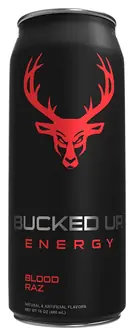 Bucked Up Blood RazBucked Up · 300 mg
Shark Score 79
Bucked Up Blood RazBucked Up · 300 mg
Shark Score 79
-
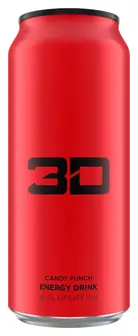 3D Candy Punch3D · 200 mgNo longer sold
Shark Score 70
3D Candy Punch3D · 200 mgNo longer sold
Shark Score 70
-
 Triton Strawberry KiwiTriton · 200 mgNo longer sold
Shark Score 79
Triton Strawberry KiwiTriton · 200 mgNo longer sold
Shark Score 79
2. Reaction time
Whether you play a physical sport or an e-sport, faster reactions are an advantage over your opponent.
Your body is always somewhere on a spectrum between a parasympathetic state (sleep is almost entirely parasympathetic) and a sympathetic one (the adrenaline of “fight or flight”). Caffeine shifts your central nervous system toward the sympathetic side, which sharpens that fight-or-flight response and, with it, reaction time.
Bert Jacobson ran a study published through the American Psychological Association on how caffeine improves reaction time. He reports that the “results indicate a significant effect between pre–posttest measurements for both reaction time and movement time favoring the 300-mg group.” That’s exactly the amount in most performance energy drinks like Bang and Reign.
It’s no surprise so many elite gamers are sponsored by energy drink companies. Sharper reactions from caffeine aren’t cheating; they’re an edge.
When picking a drink for competition, make sure the kick is strong enough to amp you up without the caffeine content running too high. Too much caffeine can make you jittery, which hurts fine motor control and your gameplay with it. Our top three for reaction time without going overboard:
-
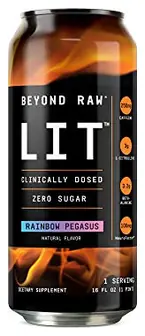 Beyond Raw Lit Rainbow PegasusBeyond Raw · 250 mgNo longer sold
Shark Score 49
Beyond Raw Lit Rainbow PegasusBeyond Raw · 250 mgNo longer sold
Shark Score 49
-
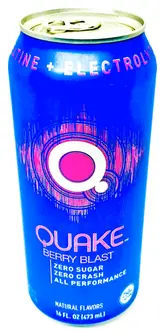 Quake Berry BlastQuake (7-Eleven) · 250 mgNo longer sold
Shark Score 70
Quake Berry BlastQuake (7-Eleven) · 250 mgNo longer sold
Shark Score 70
-
 Rockstar Pure Zero PunchedRockstar · 240 mg
Shark Score 50
Rockstar Pure Zero PunchedRockstar · 240 mg
Shark Score 50
3. Strength vs. endurance
Caffeine increases vigor, which increases overall exercise capacity. What does that mean for your workouts or your sport?
Caffeine in the gym helps with high-rep work, not max strength. Results vary by sport: you’ll get more out of an energy drink before most field sports than before a powerlifting meet. It may feel better to be amped up under a heavy bar, but it does little for actual performance. Todd Astorino explains this in the European Journal of Applied Physiology:
“Multiple studies corroborate the ergogenic properties of caffeine (CAF) for endurance performance, yet fewer investigations document the efficacy of acute caffeine intake for intense, short-term exercise… Compared to placebo, there was no effect (P > 0.05) of caffeine on muscular strength, as 1-RM bench press (116.4 ± 23.6 kg vs. 114.9 ± 22.8 kg) and leg press (410.6 ± 92.4 kg vs. 394.8 ± 95.4 kg) were similar.”
Most sports call for muscular endurance far more than one-rep-max strength. Caffeine also significantly improves aerobic endurance. Albah Cass notes in Evidence-Based Practice that it “was shown to be superior to carbs or water [in cyclists]”:
“Consumption of caffeine (around 6 mg/kg) an hour before exercise produces small to moderate improvements in endurance, particularly in increasing time to voluntary exhaustion (TVE) and ratings of perceived exertion.”
So how much should you have? The Journal of Applied Physiology reports on well-trained endurance athletes: “Endurance was enhanced with both 3 and 6 mg/kg of [caffeine] over the placebo, whereas there was no significant effect with 9 mg/kg of caffeine.”
Do the math for your bodyweight. At 180 lb (about 82 kg), 3–6 mg/kg works out to roughly 246–492 mg. For reference, a cup of coffee has about 95 mg, an 8 oz Red Bull has 80 mg, and a 16 oz Monster has 140–160 mg.
Cheat sheet: 300 mg lands inside 3–6 mg/kg for anyone between about 110 and 220 lb. Here are three performance drinks at 300 mg:
-
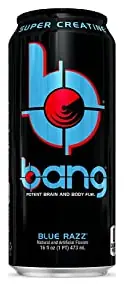 BANG Blue RazzBANG · 300 mgLeaving shelves
Shark Score 80
BANG Blue RazzBANG · 300 mgLeaving shelves
Shark Score 80
-
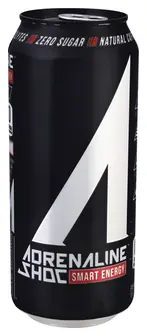 Adrenaline Shoc Shoc WaveAdrenaline Shoc · 300 mgNo longer sold
Shark Score 88
Adrenaline Shoc Shoc WaveAdrenaline Shoc · 300 mgNo longer sold
Shark Score 88
-
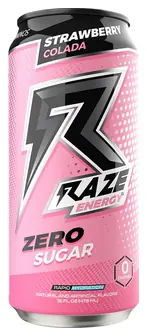 Raze Strawberry ColadaRaze · 300 mg
Shark Score 88
Raze Strawberry ColadaRaze · 300 mg
Shark Score 88
Putting it all together
Focus, reaction time, and muscular endurance matter in every sport, and improving them will take your game to the next level. Start by experimenting to find which drinks work best for you. Zero-calorie drinks like most Reign and Bang flavors advertise sports performance right on the can, and I personally reach for those because they skip the sugar.
Do they actually help? In most cases, yes. If you’re an athlete who isn’t a powerlifter or a sub-100m sprinter, the right energy drink can help you significantly. Try the nine above, or find your own favorites.
Know your limits. The FDA cites 400 mg a day as an amount not generally associated with negative effects for healthy adults. Talk to a doctor if you’re sensitive to caffeine, pregnant, or have a heart condition.